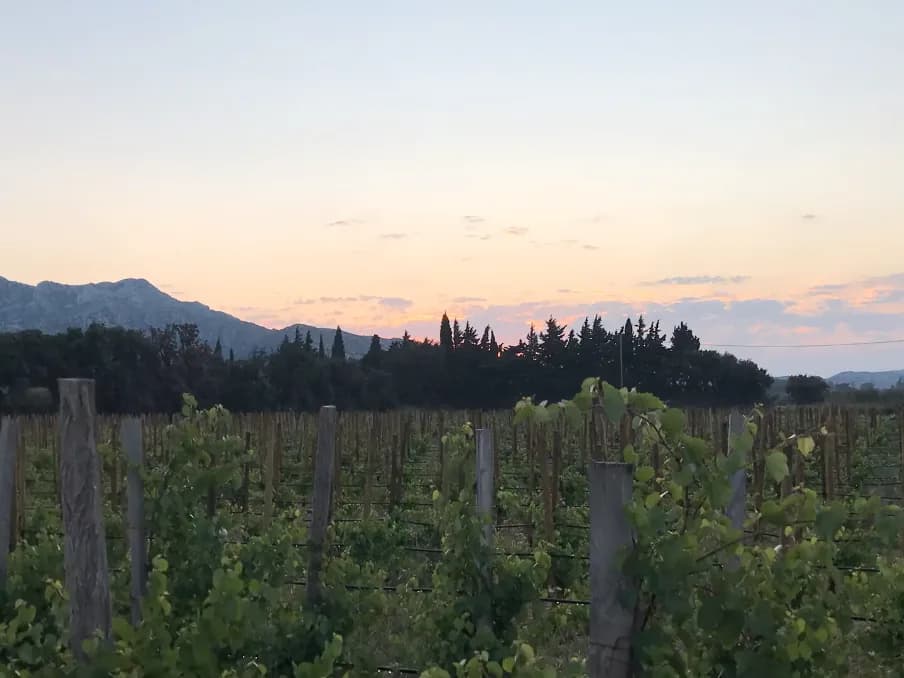
IGP Alpilles: understanding the terroir before choosing the wines
Rolled pebbles from the old Durance riverbed, clay-limestone soils, a mistral corridor: the IGP Alpilles produces wines unlike the rest of Provence. Terroir, grape varieties and style, explained through the work of the Domaine des Alpilles in Aureille.
Between Avignon to the north and Arles to the south, the Alpilles range forms a short, rugged limestone massif. The Alpilles protected geographical indication covers nineteen communes in the Bouches-du-Rhône, including Aureille, Eygalières, Saint-Rémy-de-Provence, Maussane-les-Alpilles and Les Baux-de-Provence. A larger area than the Baux-de-Provence appellation, and a terroir that often produces different wines from those associated with Provence.
Three factors that shape the style
The soil. The limestone slopes of the Alpilles are poor and free-draining. At their foot, in the old Durance riverbed, the vines grow on clay-limestone soils covered with rolled pebbles. These pebbles store the day's heat and release it at night, while limiting the water reserve: yields are naturally low and the grapes concentrated.
The mistral. The north wind dries the vineyard, which reduces disease pressure and makes it easier to farm without synthetic chemical crop protection. This is one of the reasons why organic viticulture is so widespread here.
The Mediterranean climate. Hot, dry summers, mild winters, rain on just a few dozen days a year. In this environment, the winemaker's whole art lies in preserving freshness and acidity, otherwise the wines become heavy.
The Chenin bet in Aureille
This is precisely the choice that sets the Domaine des Alpilles apart. The vineyard, 12 organically farmed hectares on an 18-hectare estate in a single block, includes ten grape varieties. For the whites: Chenin, Clairette, Roussanne, Marsanne and Carignan Blanc. For the reds: Syrah, Mourvèdre, Cinsault, Cabernet Sauvignon and Carignan.
Chenin, a Loire variety, is rarely grown in Provence. Here, on the estate's cool limestone soils, it gives Le Blanc the acidity and tension that southern whites often lack. The wine is fermented in barrels, which gives it volume without masking its freshness.
Winemaker Justine Dublé spent four years learning at the Domaine de Trévallon alongside Éloi Dürrbach, a defining figure of Alpilles wines. The estate's Syrah vines were in fact selected in the Trévallon vineyards, and more than 95% of the vineyard was planted by the Bérillon nursery using massal selection.
What the vineyard work tells us
Several technical choices explain the style of the wines and are worth knowing for anyone selling them:
- Organic since it was founded, with natural grass cover between the rows to preserve soil life.
- A high canopy that keeps a large leaf area and protects the grapes from overly direct sun.
- Hand harvesting at night, to bring in fresh grapes and limit oxidation.
- A farmed environment with 300 olive trees and 600 truffle oaks around the vines, preserving a diversity that benefits the vineyard.
These practices are not brochure arguments: they explain why the wines keep their freshness in an area where heat is the biggest challenge.
Three wines, three uses in service
Le Blanc is based on Chenin, complemented by Roussanne, Marsanne, Carignan Blanc and Clairette. Fermented in barrels. It stands up to fish with character, shellfish and aged goat's cheese.
Le Rosé combines Cinsault, Clairette and Chenin on clay-limestone soils with rolled pebbles. A rosé for the table rather than the terrace, which handles spicy Mediterranean cooking.
Le Rouge is a cuvée of Syrah, Mourvèdre, Cabernet Sauvignon and Cinsault from the pebbles of the old Durance riverbed. Several vintages are available at the same time, so you can offer a wine ready to drink and a bottle for cellaring.
All three colours come in magnum, a useful format for large tables and events.
Why this terroir is interesting for wine lists
An IGP Alpilles wine doesn't sell like a wine from a prestigious appellation: it is told. Here the sommelier or restaurant manager has a precise, verifiable and short story that makes people want to taste: a limestone massif, river pebbles, the mistral, a Loire grape variety in Provence, a winemaker trained at Trévallon.
That explains why these wines are now on the lists of Michelin-starred restaurants, including Pierre Gagnaire in Paris, Le Louis XV in Monaco, Fanny Rey in Saint-Rémy-de-Provence and La Cabro d'Or at Baumanière.
The cellar, designed by architect Gérard Minconé, has welcomed visitors for tours and tastings since April 2025. A visit remains the best way to understand a terroir before listing it.
Discover the Domaine des Alpilles →
Request a quotation for professionals →
Alcohol abuse is dangerous for your health. Please drink responsibly.